The Tripartite DBOM Model: A New Approach to Managing D&C/O&M Interface Risk
In previous articles, I argued that many of the benefits traditionally attributed to privately financed Public–Private Partnerships (PPPs) can be achieved without private finance. Performance-based service payments, whole-of-life optimisation, output specifications, lifecycle planning and handback requirements are not exclusive to PPPs. They can all be replicated under owner-funded delivery models.
One question naturally follows.
If private finance is not essential to delivering these benefits, what role is the PPP special purpose vehicle (SPV) really performing?
The answer is that the SPV does far more than raise debt and equity.
One of its most important functions is to bring together the design and construction contractor and the operations and maintenance contractor and make them collectively responsible for whole-of-life outcomes.
The SPV effectively acts as a contractual integrator, assuming the D&C/O&M interface risk that would otherwise sit with the project owner.
But does a project need a privately financed intermediary to perform that role?
Perhaps not.
This article explores a potential alternative: a Tripartite DBOM Model under which the project owner, D&C contractor and O&M contractor become parties to a single integrated contract, allowing many of the benefits of PPP-style whole-of-life integration to be achieved without a privately financed SPV.
This article is the second in a fourPart 1 – The O&M First Model: Capturing PPP Value Without Private Finance-part series examining alternative ways of achieving the principal benefits traditionally associated with privately financed PPPs. The first article explored the O&M First Model. This article examines a new approach to managing D&C/O&M interface risk.
The missing middle ground
Traditionally, project owners have faced two choices.
The first is conventional procurement. The owner engages a D&C contractor to design and construct the asset and subsequently engages an O&M contractor to operate and maintain it. The owner bears much of the interface risk between those parties.
The second is a PPP. The owner contracts with an SPV. The SPV separately engages the D&C contractor and O&M contractor and assumes responsibility for coordinating their activities and managing the interface.
One model leaves D&C/O&M interface risk largely with the owner.
The other transfers that interface risk to a privately financed intermediary.
There may be a third alternative.
A Tripartite DBOM model
Under a Tripartite DBOM model:
the project owner;
the D&C contractor; and
the O&M contractor,
become parties to a single integrated contract.
The model distinguishes between two categories of responsibility.
Allocated responsibilities
These are responsibilities allocated exclusively to one contractor.
Examples of D&C responsibilities might include:
design;
construction;
fitness for purpose;
latent defects arising from design or construction;
operability and maintainability consequences arising from design decisions;
handback deficiencies arising from design or construction defects.
Examples of O&M responsibilities might include:
operation of the asset;
maintenance;
inspections;
monitoring;
reporting;
compliance with operational procedures;
defects arising from inappropriate operation or maintenance activities.
Shared responsibilities
Some outcomes cannot realistically be allocated exclusively to either party because they depend upon both design decisions and operational performance.
Examples might include:
availability;
reliability;
energy performance;
service quality;
lifecycle performance;
handback condition; and
mixed-cause service failures.
These responsibilities are allocated jointly to the D&C contractor and the O&M contractor.
The critical difference between this model and conventional procurement is that the D&C and O&M contractors are both accountable for outcomes that depend upon effective collaboration between them.
Why project owners should care about internal allocations
A common view is that projects owners need not concern themselves with how contractors allocate responsibilities between themselves.
After all, sophisticated owners frequently obtain joint and several liability.
From a legal perspective, that may be correct.
From a delivery perspective, it often is not.
Construction joint ventures provide a useful example. Many owners devote relatively little attention to how risk and responsibility are allocated between JV participants because each participant remains jointly and severally liable to the owner.
Yet experienced project participants know that the internal arrangements between JV members can materially influence project performance.
An integrated JV will often behave differently from a split-scope JV.
Governance arrangements, voting rights, scope boundaries and internal accountability mechanisms frequently influence collaboration, decision-making and dispute frequency.
The same principle applies to the D&C/O&M interface.
In both cases, the owner's concern is not merely who ultimately bears the loss. The owner's concern is whether the contractual framework encourages the behaviours necessary to prevent interface failures occurring in the first place.
If whole-of-life value depends on effective collaboration between the D&C and O&M contractors, owners should pay close attention to how that relationship is structured.
Making lifecycle accountability explicit
One of the most powerful features of successful PPP bids is that the future operator helps shape design decisions.
In many projects, however, the assumptions sitting behind those decisions remain largely implicit.
The designer may assume particular maintenance regimes.
The operator may assume particular asset lives.
Neither set of assumptions is fully documented or tested.
Fifteen years later, the parties argue about whether the asset is under-performing because:
it was badly designed; or
it has been operated and maintained incorrectly.
The Tripartite DBOM model proposes a different approach.
Rather than leaving those matters implicit, they become expressly documented and certified throughout the design process.
The Design Performance Statement
For each major design package, the D&C contractor submits:
the design documentation;
a Design Performance Statement; and
a D&C certification.
The Design Performance Statement identifies:
the relevant Performance Requirements;
how the design satisfies those requirements;
the key design features upon which compliance depends;
the Operational Dependencies; and
the Lifecycle Dependencies.
Operational Dependencies
Operational Dependencies are the operating and maintenance activities that the D&C contractor says are necessary if the design is to continue delivering the required service outcomes.
Examples might include:
quarterly preventative maintenance;
minimum spare parts holdings;
calibration intervals;
maximum maintenance outage periods;
prescribed maintenance procedures.
Lifecycle Dependencies
Lifecycle Dependencies are the renewal and replacement activities upon which long-term performance depends.
Examples might include:
bearing replacement after 10 years;
motor replacement after 15 years;
pump replacement after 20 years;
control system upgrades after 12 years;
roof membrane replacement after 20 years.
The significance of these dependencies is that they transform previously unstated assumptions into explicit contractual propositions.
The D&C contractor is effectively saying:
If these Operational Dependencies and Lifecycle Dependencies are satisfied, the design will continue to achieve the required service outcomes throughout the operating term.
D&C certification
The D&C contractor would provide a certification with each major design submission along the following lines:
The Design Package complies with the Performance Requirements and, if the identified Operational Dependencies and Lifecycle Dependencies are satisfied, is capable of achieving the relevant service outcomes throughout the operating term.
This certification would supplement the D&C contractor's broader contractual warranty that the completed works will satisfy the Performance Requirements.
Importantly, it provides a contemporaneous record of the dependencies upon which compliance relies.
O&M review and certification
The O&M contractor then reviews the design package and associated Design Performance Statement.
Following that review, the O&M contractor provides a certification confirming that:
(a) the identified Operational Dependencies and Lifecycle Dependencies are consistent with the O&M Contractor's obligations under the Contract; and
(b) the O&M Contractor is not aware of any material reason why the design would be incapable of achieving the relevant Performance Requirements if those Dependencies are satisfied.
The distinction is important.
The O&M contractor is not warranting the D&C contractor's design.
Rather, it is confirming that:
it has reviewed the design;
it understands the dependencies identified by the D&C contractor; and
from an operational perspective, it sees no reason why the required outcomes should not be achieved if those dependencies are satisfied.
The result is a powerful accountability chain linking design decisions, operational obligations and long-term performance outcomes.
Managing shared responsibilities
The treatment of shared responsibilities is critical because this is where D&C/O&M interface risk typically arises.
The traditional approach has often been to leave significant aspects of the D&C/O&M interface to separate agreements between the contractors.
The Tripartite DBOM model adopts a more transparent approach.
The contract itself identifies:
shared responsibilities;
investigation obligations;
mitigation obligations;
presumptive allocation rules; and
dispute resolution procedures.
For example:
Design defect: D&C responsibility
Latent defect: D&C responsibility
Failure to undertake maintenance: O&M responsibility
Failure to monitor performance: O&M responsibility
Mixed-cause availability failure: Shared responsibility
Mixed-cause asset condition issue: Shared responsibility
Where a shared failure occurs, both contractors would be obliged to:
investigate;
mitigate;
restore service; and
only then determine ultimate responsibility.
The project owner receives outcomes first.
Arguments occur later.
Visualising the accountability chain
The central concept can be illustrated as follows:
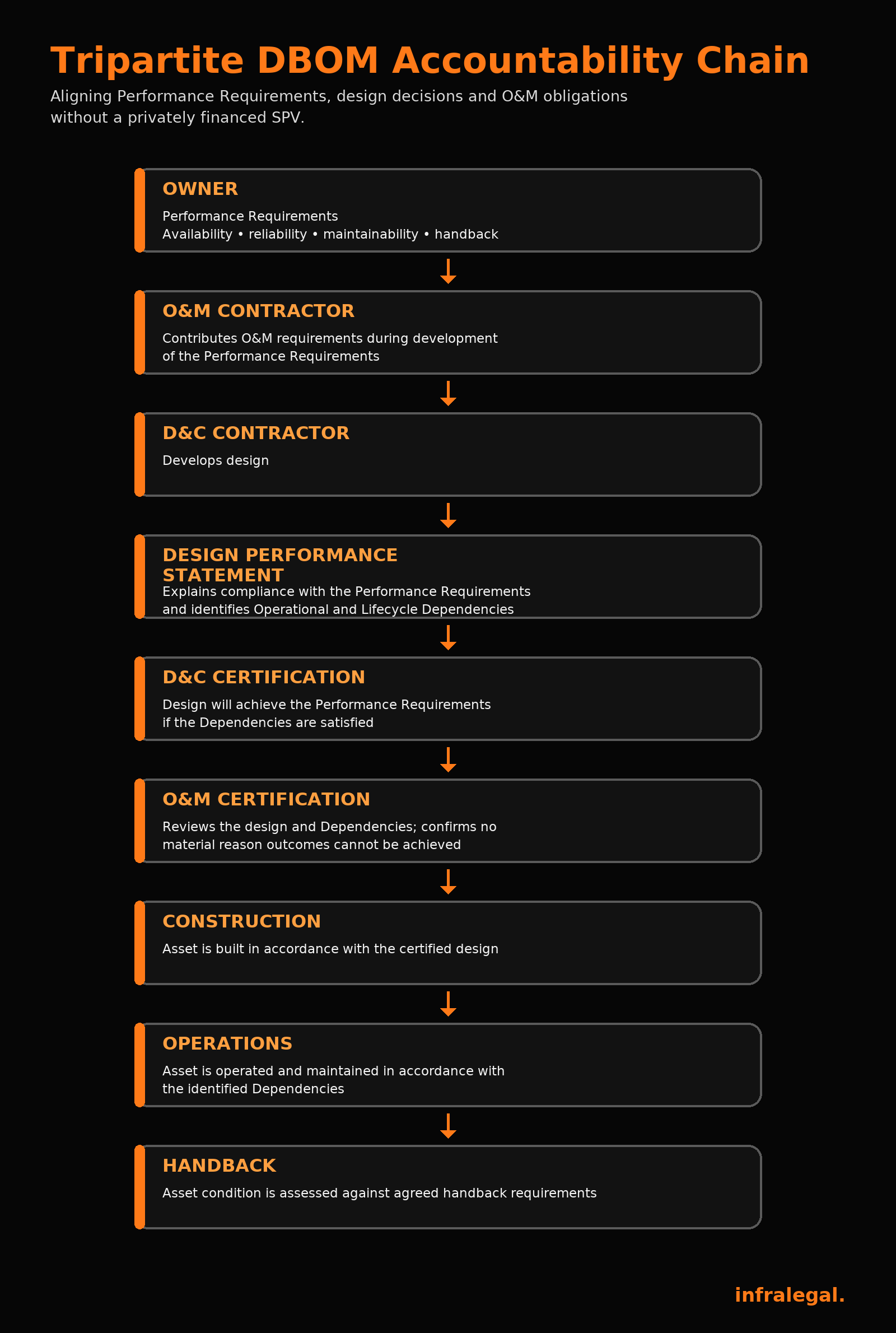
Tripartite DBOM Accountability Chain
The key insight is that whole-of-life accountability no longer depends upon a privately financed SPV sitting between the parties.
Instead, accountability is created through a transparent chain linking:
Performance Requirements;
design decisions;
Operational Dependencies;
Lifecycle Dependencies; and
ongoing operational obligations.
What does this model achieve?
The model seeks to preserve many of the benefits commonly associated with PPPs, including:
whole-of-life integration;
O&M involvement in design;
lifecycle optimisation;
transfer of interface risk from the Owner;
accountability for long-term service outcomes; and
visibility of the D&C/O&M relationship.
At the same time, it avoids:
project-finance transaction costs;
project-finance debt margins;
equity return requirements; and
the complexities associated with a financing vehicle.
Conclusion
For more than thirty years, project owners have largely been presented with two options: conventional procurement with fragmented accountability, or PPPs with privately financed integration.
The Tripartite DBOM model suggests there may be a third way.
Its real innovation is not the tripartite contract itself.
Rather, it is the explicit identification, certification and ongoing management of the Operational Dependencies and Lifecycle Dependencies upon which long-term performance depends.
By making those dependencies visible, agreed and contractually accountable, project owners may be able to transfer D&C/O&M interface risk directly to the parties best placed to manage it, while still achieving many of the whole-of-life benefits traditionally associated with PPPs.
The real question is not whether an SPV should exist. The real question is who should bear responsibility for managing the interface between design, construction and operations. The Tripartite DBOM model suggests there may be a way to transfer that responsibility without the cost and complexity of a privately financed intermediary.
Your views
This article represents my current thinking on a highly innovative variant of the PPP model. I’m keen to further develop the thinking with my In the Know readers. Please share your thoughts. Helpful contributions will be acknowledged.
This article was inspired by a research paper written by Kareen Khattab for the PPP Law course that I teach as part of the University of Melbourne’s Master of Laws program. Kareen hopes to have his research paper published in a journal soon.